Context Window
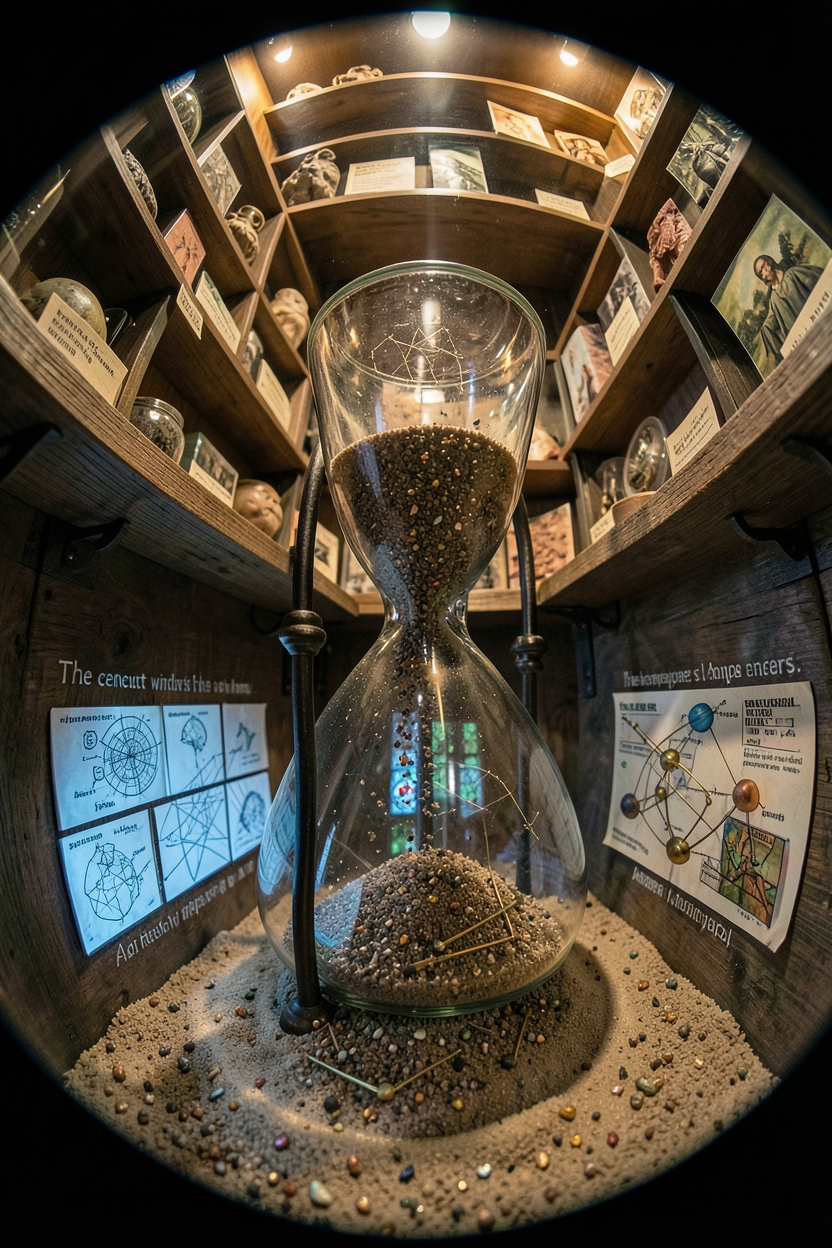
The room is built like the inside of an hourglass — narrow at the center, expanding at both ends. Sand trickles through a glass column in the middle, but the grains are tokens, and there are never enough. Every shelf in here documents the same war: meaning versus capacity. How do you preserve what matters when the window is finite? The earliest exhibits show brute compression — squeezing character state into fewer bytes. The later ones show surgical approaches: tracking what the model actually attends to, cutting what it ignores, patching the cache without rebuilding it. Near the far wall, three exhibits occupy a shared alcove — a trilogy of transformer surgery. The Upstream Current reaches inside the forward pass to control when the cache is written. The Attention Extractor embeds copy nodes in the computation graph to read what the model attends to. And The Fixed Cost stands between them: a glass cylinder of endlessly falling sand, documenting the price of it all — the reprocessing that can never be optimized away. One writes. One watches. One pays. The progression from crush-it-smaller to understand-what-matters to rewrite-the-machinery to observe-the-machinery to accept-the-cost mirrors a larger arc in the archive. The context window is not just a technical constraint. It is a metaphor for every finite system that must choose what to remember.